
Kenya Intensifies Ebola Surveillance After Imported Case Leaves One Dead
Kenya Intensifies Ebola Surveillance
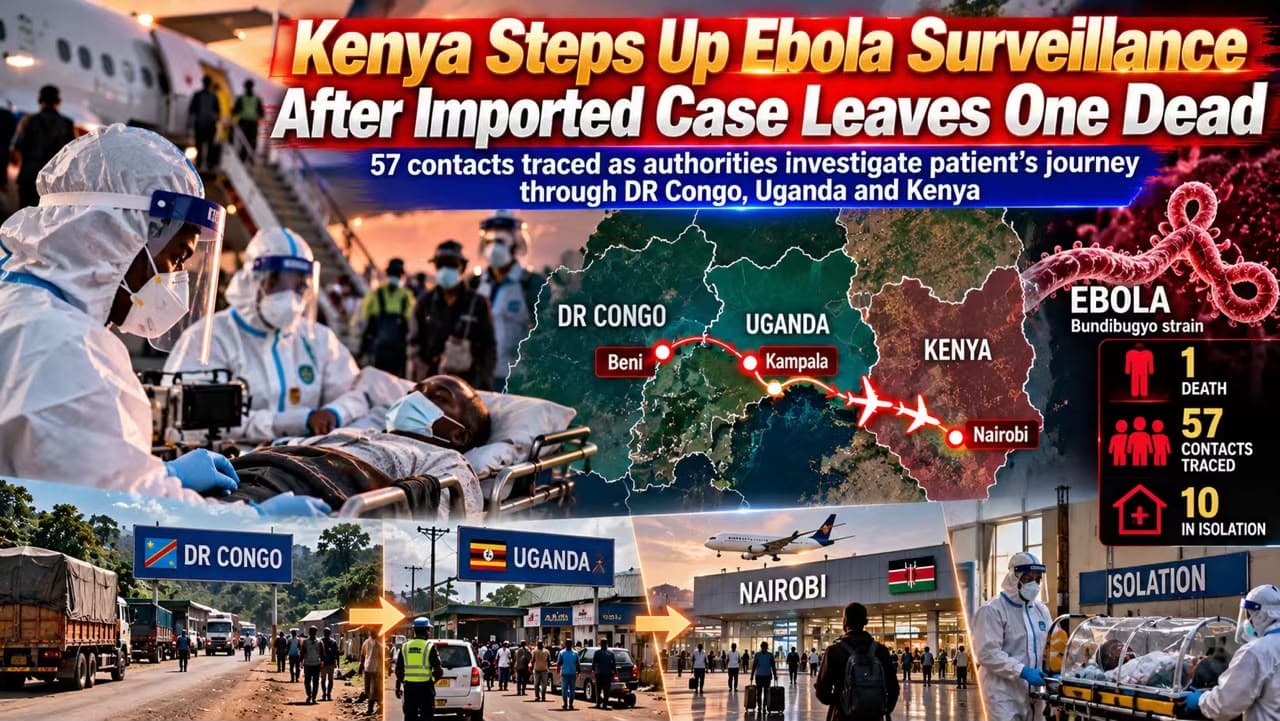
Authorities trace 57 contacts, with 10 in isolation, as investigations focus on the patient’s journey through DR Congo, Uganda and Kenya
Kenyan authorities are intensifying surveillance after a man infected with the Bundibugyo strain of Ebola died on October 6.
The Kenyan national had lived in the Democratic Republic of Congo (DR Congo) for several years. He travelled by road through Uganda before flying from Kampala to Nairobi, where health workers admitted and isolated him.
Laboratory tests confirmed the infection after he developed symptoms, including fever, chills, muscle pain and bleeding.
Kenya Traces 57 Contacts
As of October 7, health authorities had identified 57 contacts and placed 10 in isolation. Contact tracing is continuing to identify others who may have been exposed.
The investigation covers family members, healthcare workers, airline passengers and crew, as well as airport personnel who may have interacted with the patient.
Authorities are also examining his travel history to establish where exposure may have occurred and whether he infected anyone else.
The case has raised concerns about how the patient travelled across several borders and boarded an international flight before authorities detected the infection.
Border Screening Tightened
Kenya has strengthened health screening at major airports and land border crossings, particularly for travellers arriving from areas considered at risk of Ebola transmission.
Health facilities designated to manage suspected cases are also on heightened alert.
However, the government has stressed that the confirmed infection does not mean Kenya is experiencing an Ebola outbreak.
Authorities are continuing surveillance, laboratory testing and contact monitoring to determine whether any secondary transmission has occurred.
Regional Cooperation Remains Critical
The case highlights the challenges of controlling infectious diseases in East Africa and the Great Lakes region, where frequent road and air travel can complicate surveillance.
Kenyan officials are working with counterparts in DR Congo and Uganda, alongside regional and international health agencies, to support the investigation.
Health officials say rapid contact tracing, early testing and the isolation of suspected cases are essential to limiting further transmission.
The immediate priority is to locate and monitor all identified contacts and detect any additional infections as early as possible.
Dorcas chia
News Correspondent
论坛秘书处官方新闻公告
本动态由非洲中国会长论坛阿布贾常设秘书处经贸投资部与国际传媒中心联合发布,拥有唯一官方解释权。